
Ventilation:  Basic Principles
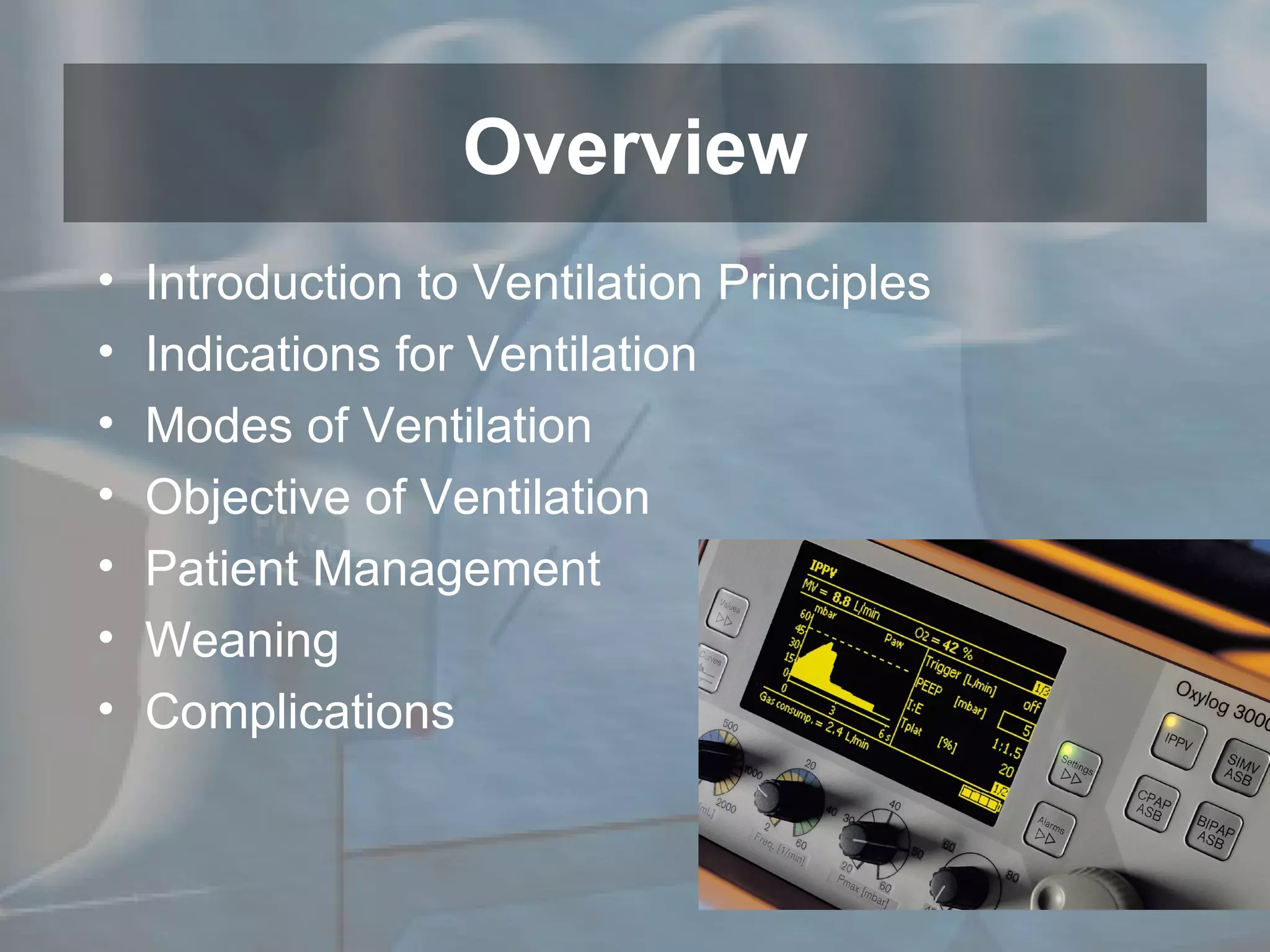
Introduction to Ventilation Principles Indications for Ventilation Modes of Ventilation Objective of Ventilation Patient Management Weaning  Complications Overview
Airway Compromise (potential) Respiratory Failure pH: <7.25 PaCO 2 :  >50 mmHg PaO 2 : <50 mmHg Increased Work of Breathing Head Injury Management Indications for Ventilation
Support though illness Reversal of hypoxemia Reversal of acute respiratory acidosis Relief of respiratory distress Resting of the ventilatory muscles Decrease in oxygen consumption Reduction in intracranial pressures Stabilisation of the chest wall Objective of Ventilation
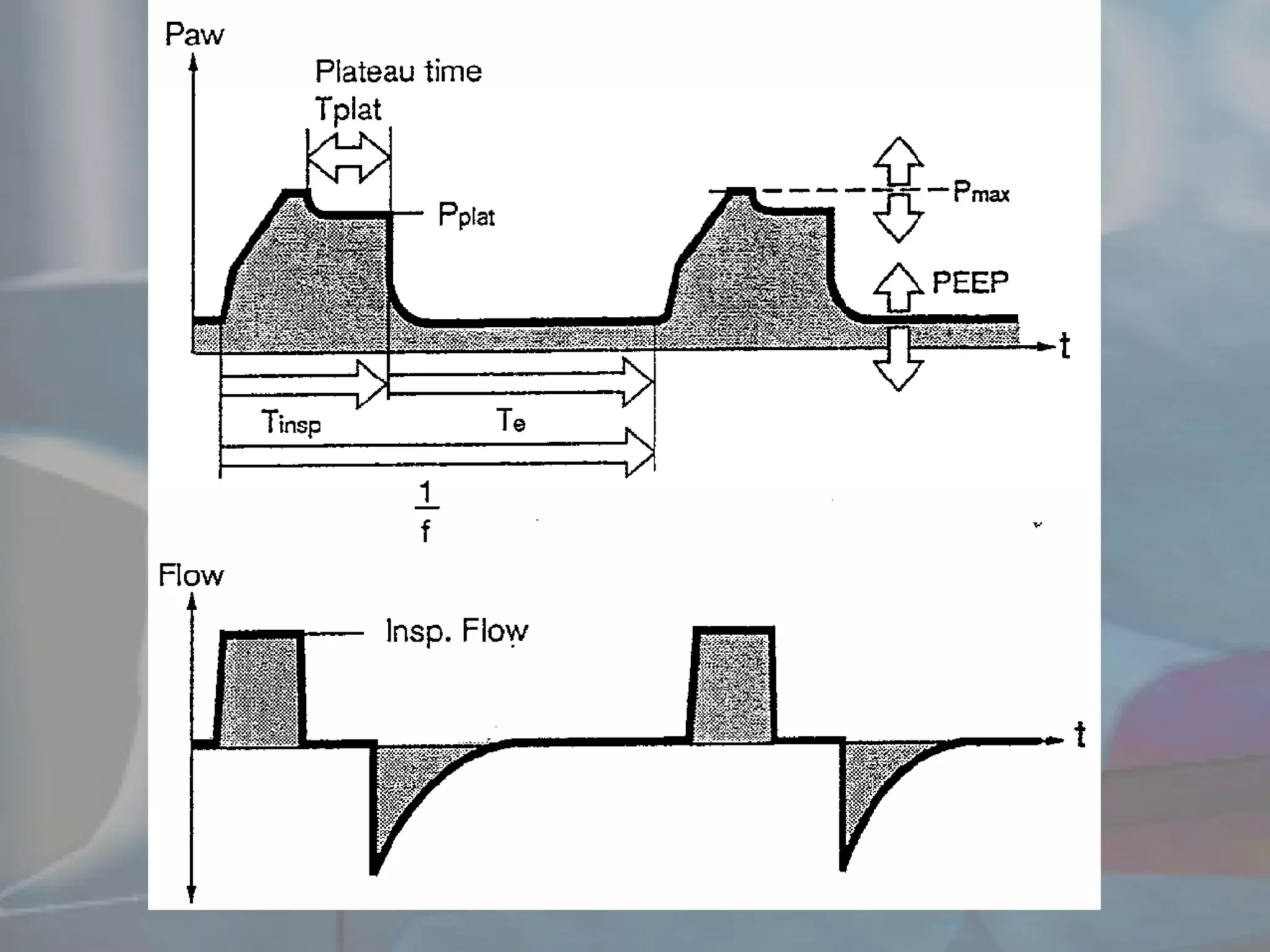
freq Vt MV I:E ratio Trigger Ramp Modes of Ventilation Pmax Paw fspn MVspn  PEEP
Controlled  Pressure Control (PC) Volume Control (VC) Supported Continuous Positive Airway Pressure (CPAP)  Pressure Support (PS) Combined SIMV (PC) + PS SIMV (VC) + PS Modes of Ventilation
Modes of Ventilation:  Control C ontrolled  M echanical  V entilation: The Minute Volume is determined by the ventilator  The patient has no option to override the ventilator
 
Modes of Ventilation:  Control P ressure  C ontrol: A preset  peak inspiratory pressure  is delivered to the patient at a preset respiratory rate Volume is not preset and is determined by the mechanics of ventilation.  (elasticity, compliance, resistance, pressure, gravity)
Modes of Ventilation:  Control V olume  C ontrol: A preset tidal volume is delivered at a present respiratory rate  7 – 10 mls/kg  50kg = 350 – 500mls 70kg = 490 – 700mls 90kg = 630 – 900mls
Modes of Ventilation:  Support C ontinuous  P ositive  A irway  P ressure: A spontaneous breathing mode, where the patient generates their own breath The ventilator maintains a constant positive pressure on expiration (PEEP) Aims to increase Functional Residual Capacity
Modes of Ventilation:  Support P ressure  S upport: A spontaneous breathing mode Need for additional support to achieve optimal tidal volumes Ventilator delivers a constant preset pressure on inspiration CPAP + PS = BiPAP
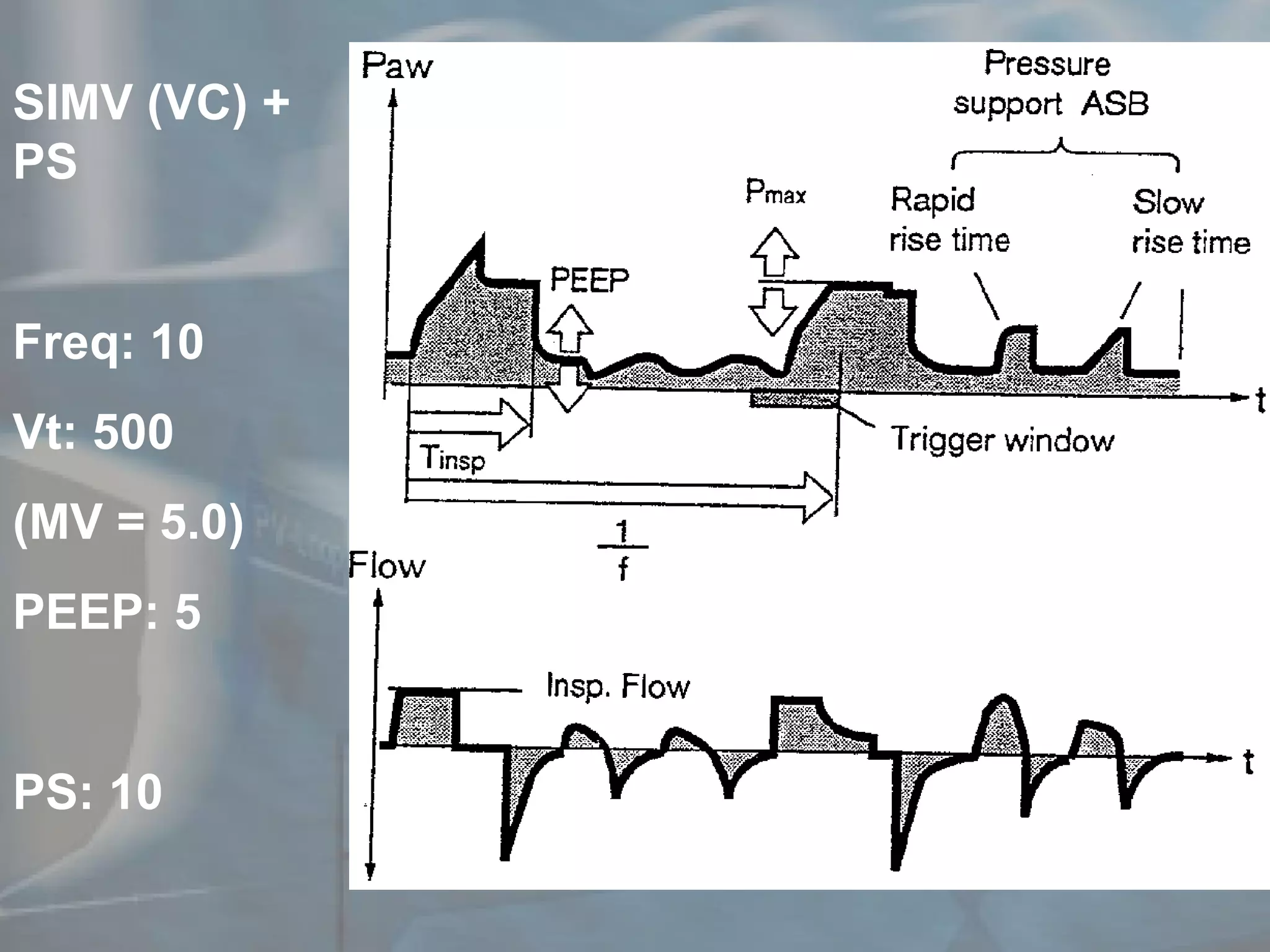
Modes of Ventilation:  Combined S ynchronised  I ntermitted  M andatory  V entilation: Similar to IMV If the patient initiates a breath and the ventilator synchronises so the ventilator doesn’t deliver a breath at the same time
Modes of Ventilation:  Combined SIMV (PC)  +  PS :   Pressure controlled ventilation with pressure support on spontaneous breaths SIMV (VC)  +  PS : Volume controlled ventilation with pressure support on spontaneous breaths
SIMV (VC) + PS Freq: 10 Vt: 500 (MV = 5.0) PEEP: 5 PS: 10
Monitoring Suctioning Other Sedation Positioning Oral and Eye Care Nutrition Elimination Communication Physiotherapy Patient Management
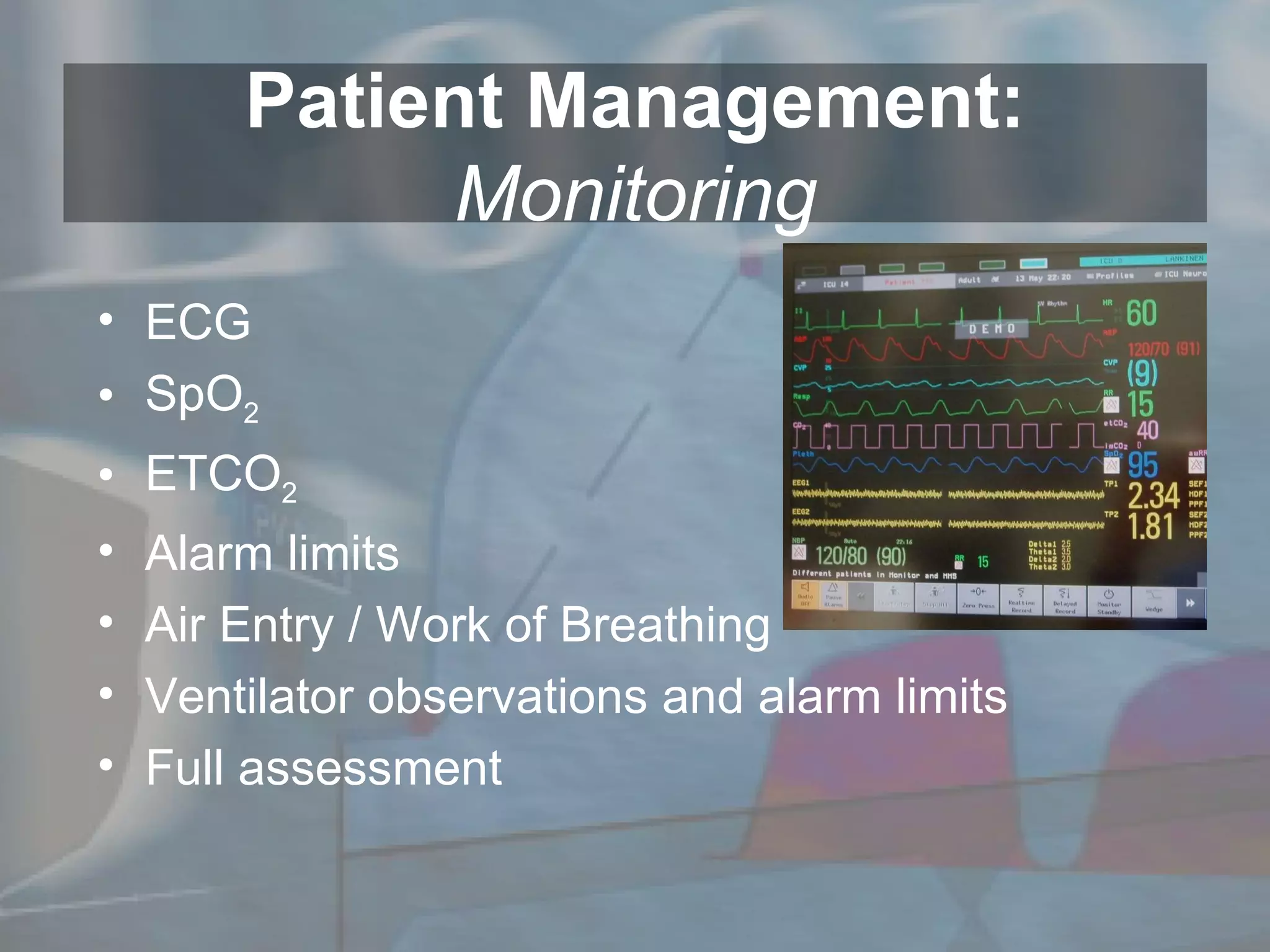
ECG SpO 2 ETCO 2 Alarm limits Air Entry / Work of Breathing Ventilator observations and alarm limits Full assessment Patient Management: Monitoring
PRN Increasing airway pressures Decreasing SpO 2 Increased work of breathing Pre-oxygenate (100% oxygen) Less than 15 Seconds Patient Management: Suctioning
Patient Management: Other Sedation Propofol, Morphine and Midazolam Positioning 2/24; consider prone ventilation Oral and eye care 2/24 Nutrition Commence ASAP Gastric ulcer prophylaxis
Patient Management: Other Elimination - NGT, IDC, Abdominal assessment Communication Physiotherapy -  Assessment of ventilation status
Readiness to wean Cardiovascular stability PaO2 > 60mmHg on FiO2 <  0.4 PEEP < 5 and PS < 10 Intact ventilatory drive Absence of major organ system failure Normal range electrolytes (Ca++, K+, MgSO4 muscle strength) Intact ventilatory drive Psychological – pt awareness, gradual process. Weaning
Process of weaning Do not exhaust patient Spontaneous breathing trials Decrease FiO2 Decrease PS and PEEP Decrease SIMV rate Failure to wean RR >35, SpO2 <90%, HR >140, anxiety, diaphoresis, use of accessory muscles Weaning
Airway Aspiration, decreased clearance of secretions, predisposition to infection Endotracheal Tube Tube kinking, sputum plug, right main bronchus intubation, tube migration, cuff failure, laryngeal oedema Mechanical Ventilator malfunction, hypoventilation, hyperventilation, barotrauma, pneumothorax  Complications
Questions

Ventilation: basic principles

  • 1.
  • 2.
    Introduction to VentilationPrinciples Indications for Ventilation Modes of Ventilation Objective of Ventilation Patient Management Weaning Complications Overview
  • 3.
    Airway Compromise (potential)Respiratory Failure pH: <7.25 PaCO 2 : >50 mmHg PaO 2 : <50 mmHg Increased Work of Breathing Head Injury Management Indications for Ventilation
  • 4.
    Support though illnessReversal of hypoxemia Reversal of acute respiratory acidosis Relief of respiratory distress Resting of the ventilatory muscles Decrease in oxygen consumption Reduction in intracranial pressures Stabilisation of the chest wall Objective of Ventilation
  • 5.
    freq Vt MVI:E ratio Trigger Ramp Modes of Ventilation Pmax Paw fspn MVspn  PEEP
  • 6.
    Controlled PressureControl (PC) Volume Control (VC) Supported Continuous Positive Airway Pressure (CPAP) Pressure Support (PS) Combined SIMV (PC) + PS SIMV (VC) + PS Modes of Ventilation
  • 7.
    Modes of Ventilation: Control C ontrolled M echanical V entilation: The Minute Volume is determined by the ventilator The patient has no option to override the ventilator
  • 8.
  • 9.
    Modes of Ventilation: Control P ressure C ontrol: A preset peak inspiratory pressure is delivered to the patient at a preset respiratory rate Volume is not preset and is determined by the mechanics of ventilation. (elasticity, compliance, resistance, pressure, gravity)
  • 10.
    Modes of Ventilation: Control V olume C ontrol: A preset tidal volume is delivered at a present respiratory rate 7 – 10 mls/kg 50kg = 350 – 500mls 70kg = 490 – 700mls 90kg = 630 – 900mls
  • 11.
    Modes of Ventilation: Support C ontinuous P ositive A irway P ressure: A spontaneous breathing mode, where the patient generates their own breath The ventilator maintains a constant positive pressure on expiration (PEEP) Aims to increase Functional Residual Capacity
  • 12.
    Modes of Ventilation: Support P ressure S upport: A spontaneous breathing mode Need for additional support to achieve optimal tidal volumes Ventilator delivers a constant preset pressure on inspiration CPAP + PS = BiPAP
  • 13.
    Modes of Ventilation: Combined S ynchronised I ntermitted M andatory V entilation: Similar to IMV If the patient initiates a breath and the ventilator synchronises so the ventilator doesn’t deliver a breath at the same time
  • 14.
    Modes of Ventilation: Combined SIMV (PC) + PS : Pressure controlled ventilation with pressure support on spontaneous breaths SIMV (VC) + PS : Volume controlled ventilation with pressure support on spontaneous breaths
  • 15.
    SIMV (VC) +PS Freq: 10 Vt: 500 (MV = 5.0) PEEP: 5 PS: 10
  • 16.
    Monitoring Suctioning OtherSedation Positioning Oral and Eye Care Nutrition Elimination Communication Physiotherapy Patient Management
  • 17.
    ECG SpO 2ETCO 2 Alarm limits Air Entry / Work of Breathing Ventilator observations and alarm limits Full assessment Patient Management: Monitoring
  • 18.
    PRN Increasing airwaypressures Decreasing SpO 2 Increased work of breathing Pre-oxygenate (100% oxygen) Less than 15 Seconds Patient Management: Suctioning
  • 19.
    Patient Management: OtherSedation Propofol, Morphine and Midazolam Positioning 2/24; consider prone ventilation Oral and eye care 2/24 Nutrition Commence ASAP Gastric ulcer prophylaxis
  • 20.
    Patient Management: OtherElimination - NGT, IDC, Abdominal assessment Communication Physiotherapy - Assessment of ventilation status
  • 21.
    Readiness to weanCardiovascular stability PaO2 > 60mmHg on FiO2 < 0.4 PEEP < 5 and PS < 10 Intact ventilatory drive Absence of major organ system failure Normal range electrolytes (Ca++, K+, MgSO4 muscle strength) Intact ventilatory drive Psychological – pt awareness, gradual process. Weaning
  • 22.
    Process of weaningDo not exhaust patient Spontaneous breathing trials Decrease FiO2 Decrease PS and PEEP Decrease SIMV rate Failure to wean RR >35, SpO2 <90%, HR >140, anxiety, diaphoresis, use of accessory muscles Weaning
  • 23.
    Airway Aspiration, decreasedclearance of secretions, predisposition to infection Endotracheal Tube Tube kinking, sputum plug, right main bronchus intubation, tube migration, cuff failure, laryngeal oedema Mechanical Ventilator malfunction, hypoventilation, hyperventilation, barotrauma, pneumothorax Complications
  • 24.

Editor's Notes

  • #8 Uncomfortable for the patient who is awake. Therefore not appropriate for the patient who is being weaned from the ventilator
  • #12 Ventilator maintains a constant PEEP Supported ventilation is used only on spontaneously breathing patients with their own respiratory drive and therefore the ability to generate their own breath such as: pneumonia, cardiogenic pulmonary oedema, post-operative hypoxia, lung collapse, asthma ,etc…